
Related News
- 00
0000-00
Biosafety Laboratory Design: Planning Layout, Airflow and Containment - 00
0000-00
Choosing Exterior Doors and Windows: Materials, Insulation and Security - 00
0000-00
Manufacturing Industry Market Analysis: Demand and Supply Chain Shifts - 00
0000-00
Choosing Furniture Hardware: Load Capacity, Fit, and Mounting Requirements - 00
0000-00
Renewable Energy Price Trends: Why Solar and Wind Power Prices Fluctuate
Weekly Insights
Stay ahead with our curated technology reports delivered every Monday.
How Isolation Technology Controls Contamination During Aseptic Transfers
Every aseptic transfer creates a potential pathway for contamination, even within a well-controlled cleanroom. Using isolation technology to control contamination requires more than installing a physical barrier: transfer interfaces, decontamination cycles, pressure differentials, and operator interventions must work as an integrated system. A chamber can perform well in isolation and still become vulnerable when materials enter, samples leave, or a blocked component requires manual recovery.
The practical question is not simply whether an isolator provides clean air. It is whether each transfer preserves the required conditions at the point where sterile product, components, or product-contact surfaces become exposed. That distinction separates a convincing equipment specification from a defensible aseptic process.
Follow the material, not just the cleanroom classification
Consider a tray of sterilized components moving from preparation into a filling isolator. Its contents may be sterile, but the outside of its packaging has passed through handling and storage. If that outer surface enters the critical zone without an effective transfer strategy, the isolator has imported contamination rather than excluded it.
A useful assessment follows every surface through the transfer. Which surfaces are sterile? Which are only cleaned or disinfected? Which will touch a glove, tool, chute, or product-contact component? Where is packaging removed, and can the removal action release particles toward exposed materials? These questions often reveal weaknesses that a room classification report cannot.
ISO 14644-1 classifies air cleanliness by particle concentration. It does not, by itself, establish microbiological control or demonstrate that a transfer is aseptic. For sterile medicinal-product manufacturing, EU GMP Annex 1 places transfer arrangements within the broader contamination control strategy. Other jurisdictions and applications require their own regulatory mapping; a pharmaceutical transfer design should not be assumed suitable for every laboratory or industrial process.
The barrier only works if its interfaces remain controlled
An isolator separates the critical working environment from surrounding personnel and room air. Filtered air, a sealed enclosure, glove interfaces, and controlled transfer devices reduce direct exposure. They do not remove the need to manage contaminated external surfaces.
Rapid transfer ports illustrate this distinction. A typical alpha-beta arrangement combines a fixed port on the isolator with a compatible transfer container. When correctly docked and operated, the coupled doors keep their external faces together while opening a passage into the enclosure. The exact protection depends on port geometry, seals, docking accuracy, operating sequence, and the condition of both mating parts.
The junction deserves particular attention. The peripheral interface, sometimes described as a “ring of concern,” can present a contamination risk if transferred items or handling tools contact it. Protective sleeves, transfer guides, or other engineered arrangements may reduce that risk, but their suitability must be demonstrated for the actual material path. A successful docking signal is not proof that every subsequent movement is safe.
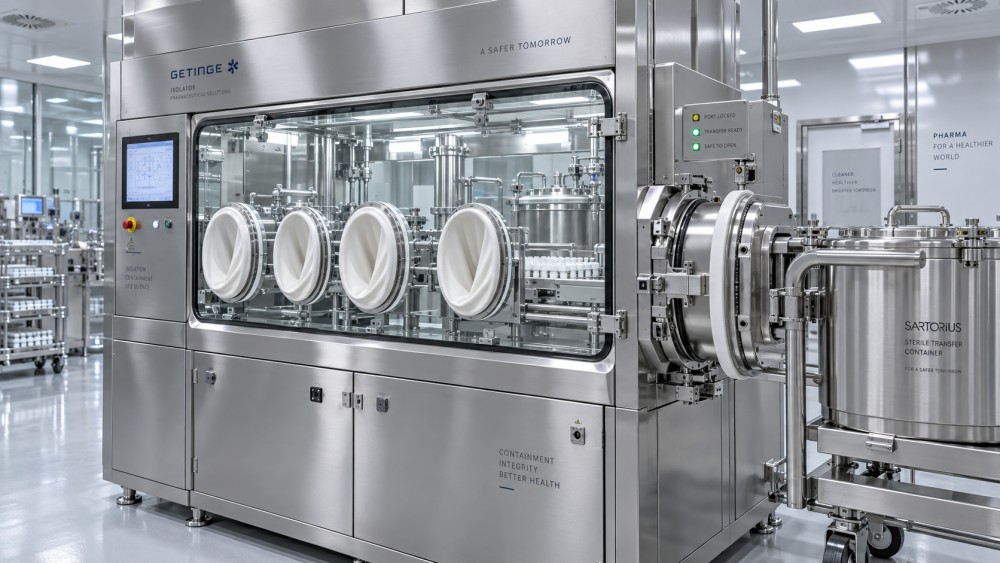
During design review, trace the port through docking, opening, transfer, closing, and undocking. Ask what prevents an incorrect sequence, how seal damage is detected, and what happens after an interrupted operation. Also check compatibility across reusable containers and disposable transfer assemblies. Apparent mechanical fit is not sufficient evidence of a qualified interface.
Choose the route around the material
A rapid transfer port is not automatically the best route for every item. Bulky equipment may need a dedicated transfer chamber. Heat-compatible components may suit a sterilization route connected to the process. Liquids may be better transferred through a qualified closed connection rather than moved in an open vessel.
Each option shifts the validation burden. A transfer chamber requires evidence for surface treatment and door sequencing; a sterile connector requires evidence for connection integrity and correct assembly. A closed liquid path also needs attention to vent filters, sampling points, hold time, and disconnection. “Closed” describes an architecture, not an automatic assurance of sterility.
Decontamination must reach the difficult surfaces
Vaporized hydrogen peroxide is commonly used for isolator bio-decontamination, but naming the agent says little about cycle performance. Effectiveness depends on exposure conditions, distribution, surface accessibility, material compatibility, and the configuration of the load.
A loosely arranged qualification load may expose surfaces that become shielded during routine production. Nested items, folded bags, contact points, and absorbent materials can change the challenge. The validated loading pattern should therefore be an operating requirement, not merely a photograph in a qualification report.
Biological indicators can help demonstrate cycle efficacy at justified challenge locations, alongside relevant physical measurements. Indicator selection, placement, recovery methods, and acceptance criteria need a scientific rationale. A passing indicator at an accessible location does not establish efficacy inside an inaccessible assembly.
Keep surface bio-decontamination separate from sterilization of the transferred contents. Treating a package exterior does not prove that its contents are sterile. Likewise, a sterile interior does not make its exterior safe to introduce into the isolator. Both claims require evidence appropriate to their purpose.
Aeration can also become the operational bottleneck. Residual decontaminant may affect sensitive materials, cells, assays, or product quality. Release criteria should address those risks as well as personnel exposure. When comparing cycle times, confirm that suppliers include conditioning, exposure, and aeration under representative loading conditions—not just the shortest phase.
Pressure protects a direction, not every hazard
Positive pressure relative to the surrounding room is commonly used for product protection because leakage tends outward. Hazardous biological agents or potent materials may require inward airflow or negative pressure for containment. These objectives are different, and some processes need both.
A negative-pressure isolator can support aseptic work when its complete design protects the internal critical zone. A positive-pressure aseptic isolator, however, should not be treated as a biosafety containment device merely because it has gloves and a sealed enclosure. Exhaust treatment, filter arrangements, leak integrity, waste handling, and failure response need separate assessment.
NSF/ANSI 49 addresses Class II biosafety cabinetry; it is not a general qualification standard for aseptic isolators. Neither a cabinet classification nor a cleanroom classification replaces process-specific evidence. This distinction matters when comparing equipment across pharmaceutical manufacturing, research laboratories, and high-containment facilities.
Pressure readings also need context. A stable value with doors closed may conceal short disturbances during transfer-chamber operation, glove movement, or exhaust changes. Airflow visualization under representative operating conditions can reveal whether air moves toward or away from exposed critical sites. Alarm limits and recovery rules should reflect the assessed risk, rather than a universal pressure number.
Qualify the awkward operation, not only the smooth one
Routine transfers are often straightforward. The more revealing situations are a partially docked container, a dropped component, a misaligned tray, or a transfer paused while an operator resolves a fault. These foreseeable events belong in design review and procedural planning before production begins.
Glove access is a common source of compromise. An operator may technically reach a component but need to stretch across exposed materials or brush against a port edge. Layout evaluation should include realistic tools, loads, viewing angles, and operator reach. Automation can reduce repetitive handling, but it introduces its own recovery interventions when sensors, grippers, or transfer mechanisms fail.
For GMP aseptic manufacturing, aseptic process simulation should represent the relevant transfer sequence and interventions, including justified challenging conditions. It complements rather than replaces engineering qualification. A satisfactory simulation cannot compensate for an uncharacterized leakage path or an unsupported decontamination claim.
Glove integrity testing, inspection, and replacement arrangements also need defined procedures. Test methods and frequency should follow applicable requirements and process risk. If a defect is found, the investigation must consider when it could have occurred and which operations may have been affected; replacing the glove alone does not resolve potential product impact.
What evidence makes two solutions meaningfully comparable?
The most useful comparison is a requirements-to-evidence review. Global Lab-Controlled Environment & Biosafety (G-LCE) brings together benchmarking across controlled environments, containment, automation, and related utility systems. For aseptic transfers, the value of that cross-disciplinary perspective is recognizing that strong performance in one category does not prove suitability in another.
- Boundary integrity: Defined leak-test methods, acceptance criteria, seal arrangements, and treatment of ports, gloves, and service penetrations.
- Transfer protection: Evidence for the actual load, exposed surfaces, docking sequence, and measures preventing contact with potentially contaminated interfaces.
- Cycle reproducibility: Qualified loading patterns, relevant challenge locations, aeration endpoints, and change-control triggers.
- Failure behavior: Documented responses to power loss, ventilation faults, incomplete docking, and interrupted cycles, including restart restrictions.
- Lifecycle support: Access to replacement seals and gloves, calibration requirements, maintenance boundaries, and requalification expectations after changes.
Environmental monitoring should support this evidence without being mistaken for proof that every transfer remained contamination-free. Sampling locations must be justified, and sampling activities must not undermine critical airflow or introduce unnecessary handling. Trends and deviations become more useful when linked to transfer events, load configurations, and interventions.
Before approving a design, select one representative inbound transfer and one outbound transfer. Walk each through normal operation, a credible interruption, and recovery. If the team cannot explain which surfaces remain protected, what evidence supports that protection, and when the operation must stop, the design is not yet ready—regardless of how impressive the isolator specification looks.
Related News
- How Isolation Technology Controls Contamination During Aseptic TransfersOct 21, 2026Explore isolation technology to control contamination during aseptic transfers. Learn how validated ports, decontamination, and pressure controls protect critical surfaces.
- How Do You Assess Isolator Containment Performance Before Purchase?Oct 13, 2026How do I assess containment performance before purchase? Discover essential isolator tests, supplier evidence, and acceptance criteria to compare systems and buy with confidence.
- How to Choose Containment Systems in North America for Chemical and Pharma FacilitiesJul 12, 2026Containment systems North America buyers trust start with risk, compliance, and performance. Learn how chemical and pharma facilities choose safer, flexible solutions.
- Absolute Purity Engineering matters most where failure spreadsMay 16, 2026Absolute Purity Engineering protects critical environments from contamination, failure spread, and compliance risk. Discover how integrated control boosts safety, uptime, and product integrity.