
Related News
- 00
0000-00
Biosafety Laboratory Design: Planning Layout, Airflow and Containment - 00
0000-00
Choosing Exterior Doors and Windows: Materials, Insulation and Security - 00
0000-00
Manufacturing Industry Market Analysis: Demand and Supply Chain Shifts - 00
0000-00
Choosing Furniture Hardware: Load Capacity, Fit, and Mounting Requirements - 00
0000-00
Renewable Energy Price Trends: Why Solar and Wind Power Prices Fluctuate
Weekly Insights
Stay ahead with our curated technology reports delivered every Monday.
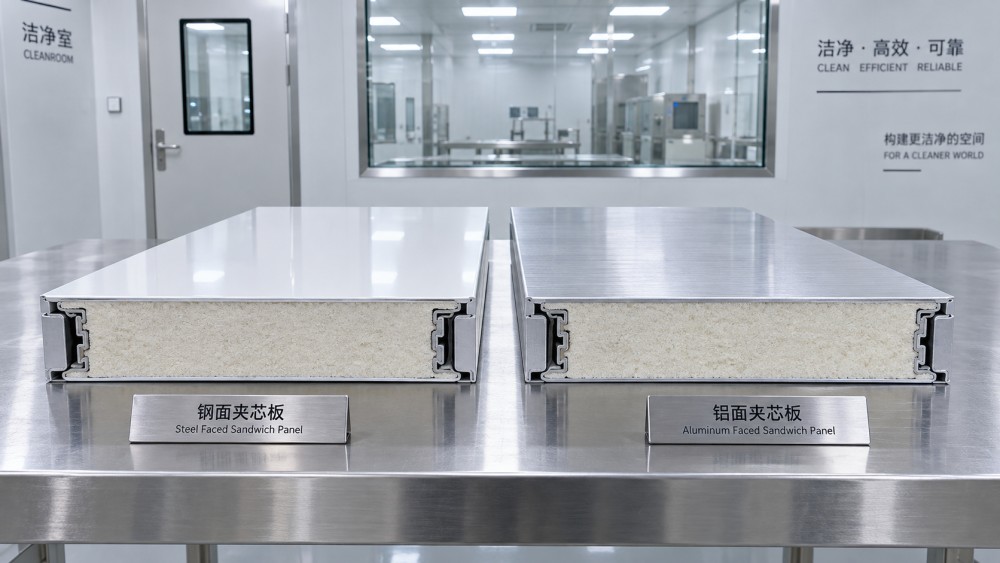
Steel facings are a strong starting point where modular cleanroom panels must resist mechanical abuse, while aluminum deserves closer consideration where handling weight and supporting-structure loads are constrained. Neither material is inherently the cleaner or more compliant option. Surface finish, chemical exposure, edge protection, and panel construction can outweigh the difference between the two metals.
The first specification question is therefore not simply “steel or aluminum?” It is which steel grade or aluminum alloy, at what facing thickness, with which coating, bonded to which core. A comparison that leaves these variables undefined can mistake a lightweight but reinforced aluminum panel for a mechanically weaker alternative—or treat coated carbon steel and stainless steel as interchangeable when their corrosion behavior is substantially different.
Define the facing before comparing the panel
“Steel-faced” can describe galvanized steel with an organic coating, another coated carbon-steel construction, or stainless steel. These options do not share the same maintenance requirements. Coated steel depends on the integrity of its finish and underlying protective treatment. Stainless steel relies on a passive surface film, but its resistance still depends on grade, surface condition, and exposure.
Aluminum specifications require similar precision. Alloy, temper, pretreatment, and finish influence forming, strength, corrosion performance, and repairability. Painted aluminum and anodized aluminum should not be treated as equivalent cleaning surfaces. Their response to disinfectants and their options for repairing scratches can differ.
A meaningful comparison should identify:
- Facing metal grade or alloy, nominal thickness, and thickness tolerance.
- Surface treatment, coating chemistry, finish thickness, and exposed-edge treatment.
- Core material, core density, adhesive system, and overall panel thickness.
- Joint geometry, sealant, gaskets, frame materials, and reinforcement around openings.
- Whether both panel faces have the same construction and exposure conditions.
These details establish whether competing proposals differ only in facing metal or are fundamentally different panel systems. That distinction matters because cleanability, stiffness, fire behavior, and leakage are properties of the installed assembly, not merely of its outer sheet.
Weight savings are real, but equal thickness is not equal performance
Aluminum has a density of approximately 2,700 kg/m³, compared with roughly 7,850 kg/m³ for carbon steel. At equal sheet thickness, an aluminum facing therefore weighs about one-third as much. As an illustrative calculation, two 0.5 mm facings contribute approximately 2.7 kg/m² in aluminum and 7.9 kg/m² in carbon steel, excluding coatings, core, adhesive, frames, and hardware.
This difference can affect lifting arrangements, manual handling, freight weight, and loads on existing structures. It is particularly relevant for large modules, retrofit access routes, and ceiling systems. However, the percentage reduction in complete-panel weight will be smaller than the reduction in facing weight, and thicker aluminum skins or additional reinforcement can reduce the saving further.
Steel also has a substantially higher elastic modulus: approximately 200 GPa, versus about 70 GPa for aluminum. Equal-thickness steel sheet consequently provides greater elastic stiffness. That does not translate directly into a fixed advantage for the finished panel. Sandwich-panel behavior also depends on the separation between facings, core shear properties, adhesive bonding, support spacing, and connection design.
For wall panels, assess deflection under the specified pressure differential and any foreseeable incidental loading. For ceiling panels, distinguish self-supporting performance from permission to carry maintenance personnel or services. A panel that spans between supports is not automatically walkable, and neither steel nor aluminum facings establish that capability without supporting assembly data.
Impact resistance must account for the core beneath the skin
A trolley striking a wall creates a different demand from uniform air pressure. Local indentation depends on the facing’s strength and thickness, but also on how effectively the core supports it. A thin skin over a compressible core can dent even when the panel has adequate overall bending stiffness.
Steel can offer an advantage in damage-prone areas, but material name alone does not establish that advantage. Aluminum alloys and tempers vary considerably, and thicker aluminum skins can improve local performance. Comparisons should use the proposed finished construction rather than unsupported sheet samples.
The operational issue is not only whether a dent remains visible. Damage can fracture a coating, loosen a bond, distort a joint, or create a depression that is difficult to clean. Where carts, mobile equipment, or door hardware create predictable contact points, a replaceable protective rail or local reinforcement may be more effective than increasing facing thickness across every wall.
Request impact evidence that describes the impactor, energy, support arrangement, and acceptance criteria. “Impact resistant” without a defined test does not show whether the panel remains cleanable and sealed after damage.
Cleaning chemistry can reverse the apparent corrosion advantage
Aluminum forms a protective oxide film, but this does not make it universally resistant to cleaning agents. Strongly alkaline or acidic solutions can attack aluminum, while chlorides can promote localized corrosion under unfavorable conditions. An organic coating may isolate the metal during normal service, yet scratches, cut edges, and drilled penetrations expose the underlying substrate.
Coated galvanized steel has a different protection mechanism. The coating provides a barrier, and the zinc layer offers additional corrosion protection. Persistent moisture, chemical exposure, and damage at seams or edges can still cause deterioration. Stainless steel avoids dependence on a paint layer for basic corrosion resistance, but chlorides and unsuitable cleaning practices can cause pitting or crevice corrosion. Grade selection remains important.
Compatibility must cover the actual cleaning procedure: chemical identity, working concentration, temperature, dwell time, application method, rinsing, and frequency. A surface that tolerates a brief wipe may not tolerate repeated wet exposure or concentrated residue left behind after evaporation.
Vapor-phase decontamination also requires evidence for the complete material combination. Hydrogen peroxide exposure, for example, should be assessed for coatings, sealants, gaskets, adhesives, and exposed metals under the intended cycle conditions. A statement that the metal is compatible does not demonstrate that the panel system will retain adhesion, appearance, and sealing performance.
Useful evidence includes repeated-exposure tests and examination for blistering, discoloration, loss of adhesion, corrosion, and changes in surface texture. Where the cleaning regime is demanding, test representative joints and exposed edges as well as flat coated coupons. Those details are more likely to reveal vulnerability than an undamaged central surface.
Edges and interfaces can matter more than the visible wall surface
Flush, smooth facings support cleaning only if their interfaces remain equally cleanable. Recessed seams, poorly finished penetrations, exposed core, and deteriorating sealant can compromise either steel or aluminum panels. Panel replacement and service modifications should preserve the same edge protection and sealing approach as the original installation.
Aluminum introduces an additional interface consideration when it contacts dissimilar metals. Galvanic corrosion requires an electrically connected metal pair and an electrolyte; a dry indoor joint is not equivalent to one repeatedly wetted by cleaning solution. Stainless-steel fasteners, steel frames, and aluminum facings should therefore be evaluated together, with suitable isolation and drainage or sealing where exposure warrants it.
Both facing metals conduct heat readily. Overall insulation is largely determined by the core, but metallic frames and connections can create thermal bridges. If a panel separates spaces with different temperatures or humidity levels, localized condensation can introduce corrosion and hygiene problems. The relevant assessment is the joint’s surface temperature relative to dew point, not simply the nominal insulation value of the panel center.
Aluminum also expands more with temperature than steel. The difference becomes relevant across long panel runs, temperature cycling, or mixed-material connections. Joint movement allowances and sealant capability should accommodate the anticipated movement rather than rely on rigid restraint.
Cleanroom classification does not select the facing metal
ISO 14644-1 classifies air cleanliness by particle concentration; it does not prescribe steel or aluminum wall facings. Achieving a specified class depends on the combined performance of airflow, filtration, operations, cleaning, and the enclosure. Describing a sheet material as “ISO Class 5 compliant” does not, by itself, establish the suitability of a panel system or the performance of an installed room.
Likewise, GMP suitability cannot be inferred from metal type. Applicable requirements and contamination-control needs must be translated into verifiable attributes such as cleanable surfaces, resistance to the cleaning regime, maintainable joints, and control of damage or particle shedding.
Where pressure control or containment is important, request leakage evidence for joints, doors, penetrations, and their interfaces under the specified pressure conditions. A chemically resistant facing can still belong to a poorly sealed enclosure. High-containment applications also require evaluation beyond an ordinary cleanroom panel specification.
Fire performance must remain a separate acceptance gate. Neither facing choice proves the reaction-to-fire or fire-resistance performance of a panel containing a combustible core or adhesive. Reports should match the proposed core, facing thickness, joints, fixings, orientation, and other relevant construction details under the applicable requirements.
Make the selection against the failure conditions that matter
Coated steel is a defensible choice where resistance to handling damage, rigid wall construction, and manageable repair procedures are priorities, provided the specified finish tolerates the cleaning environment. Aluminum is a defensible choice where lower installed mass produces a meaningful structural or handling benefit, provided the proposed thickness, backing, and connections meet the mechanical requirements.
If aggressive wet cleaning drives the decision, stainless steel may warrant comparison as a distinct option rather than being grouped with coated carbon steel. It is not a universal answer: grade, surface finish, weld or fabrication condition, and crevice design still determine suitability.
Before approval, the supplier’s evidence should resolve the project’s actual failure conditions. That means load and deflection data for the intended spans; impact performance where contact is foreseeable; chemical exposure data matching the sanitation regime; and documented construction details for joints, penetrations, and repairs. Generic brochures cannot substitute for evidence tied to the proposed assembly.
Lifecycle cost should then include the consequences of damage. A lower-priced facing may lose its advantage if repair requires extended shutdown, extensive recoating, or whole-panel replacement. An aluminum weight saving may have little financial value in an easily accessible wall installation but substantial value where lifting capacity or ceiling dead load limits the design.
The preferred facing is the one whose advantages address a real project constraint without creating an unverified weakness elsewhere. Freeze the selected alloy or grade, thickness, finish, core, and joint construction in the specification, and require approval for substitutions. Otherwise, a technically sound steel-versus-aluminum assessment can be undermined by a delivered panel that differs from the assembly actually evaluated.
Related News
- Modular Cleanroom Panels: Comparing Steel and Aluminum Facing MaterialsOct 18, 2026Choosing modula cleanroom panels? Compare steel and aluminum facings for weight, durability, cleaning compatibility, and lifecycle costs to select the right system.
- Choosing Mobile Controlled Environment Room Door Panels for Repeated CleaningOct 17, 2026Choose mobile controlled environment room door panels for repeated cleaning. Discover how materials, edge seals, and gaskets support durability and cleanability—and what to check before buying.
- How to Evaluate Modular Cleanrooms for Pharmaceutical Expansion ProjectsAug 19, 2026Modular cleanrooms for pharmaceuticals: learn how to evaluate GMP fit, contamination control, scalability, and lifecycle value for faster, lower-risk pharma expansion projects.
- How to Evaluate a White Cement Supplier for Color Consistency, MOQ, and Lead TimeJul 14, 2026White cement supplier evaluation guide: learn how to compare color consistency, MOQ flexibility, and lead time reliability to reduce sourcing risk and choose with confidence.