
Related News
- 00
0000-00
Biosafety Laboratory Design: Planning Layout, Airflow and Containment - 00
0000-00
Choosing Exterior Doors and Windows: Materials, Insulation and Security - 00
0000-00
Manufacturing Industry Market Analysis: Demand and Supply Chain Shifts - 00
0000-00
Choosing Furniture Hardware: Load Capacity, Fit, and Mounting Requirements - 00
0000-00
Renewable Energy Price Trends: Why Solar and Wind Power Prices Fluctuate
Weekly Insights
Stay ahead with our curated technology reports delivered every Monday.
The standards that apply to a cleanroom project follow from the process, the product, and the jurisdictions governing the operation and its output. ISO 14644 establishes the framework for airborne particle classification and related cleanroom testing. Pharmaceutical manufacturing adds applicable good manufacturing practice (GMP) requirements; sterile medicinal products intended for the European Union bring EU GMP Annex 1 into scope. Biological containment and semiconductor production introduce different requirements that a particle classification alone cannot address.
Begin by separating legally applicable requirements, technical standards used to demonstrate performance, and contractual specifications. A project can satisfy an ISO particle classification while failing its applicable manufacturing or containment requirements. The practical starting point is a documented applicability decision that connects each requirement to a specific activity, location, or product.
Define the operation before choosing a cleanliness class
“An ISO Class 7 cleanroom” is an incomplete design brief. It leaves unresolved whether the space supports sterile filling, medical device assembly, semiconductor processing, or work with infectious material. Those activities impose different controls even when they share an airborne particle target.
Establish the project boundary using the following information:
- Product and process: Identify what is exposed to the room environment, at which stages, and whether contamination can be removed or controlled later.
- Regulatory geography: Record the facility location and intended product markets. Export manufacturing can bring requirements associated with the destination market into the project.
- Contamination hazards: Distinguish particles, microorganisms, chemical residues, molecular contamination, and cross-contamination between products.
- Containment needs: Biological agents, potent compounds, and hazardous chemicals require an assessment of exposure and release pathways.
- Operating conditions: Define equipment, occupancy, material transfers, cleaning activities, and whether the process remains closed during routine operation.
A sealed processing system with controlled connections presents a different room-level exposure profile from an open filling operation. However, “closed” needs evidence: sampling, maintenance, disconnections, and foreseeable failures can expose the process. Establish those boundaries before assigning room grades or pressure relationships.
Match the project to the applicable requirement layers
The following distinctions help prevent a technical benchmark from being mistaken for a complete compliance framework.
These categories can overlap. A facility producing a biological medicinal product can require both GMP controls and biological containment. Local building, fire, occupational safety, and environmental requirements also apply within their respective scopes. Keep their acceptance criteria distinct so that evidence for one requirement is not incorrectly used to close another.
Use ISO 14644 for the questions it actually answers
ISO 14644-1 classifies air cleanliness by particle concentration. ISO 14644-2 addresses monitoring that provides evidence of cleanroom performance related to airborne particle concentration. ISO 14644-3 describes test methods. Select the relevant parts and editions explicitly; a specification stating only “compliant with ISO 14644” leaves the required scope unclear.
The classification must identify the occupancy state, relevant particle sizes, and physical boundary being assessed. An at-rest result describes a different condition from an operational result. Equipment movement, personnel activity, and material handling introduce contamination sources that an empty-room assessment cannot represent.
An ISO class does not establish sterility. Particle counts do not identify whether particles contain viable microorganisms. A satisfactory classification also does not establish acceptable surface cleanliness, chemical purity, airflow protection at a critical operation, or containment of a hazardous substance.
Avoid deriving the entire HVAC design from the class number. Airflow volume, filtration, room geometry, heat loads, and contamination generation interact. Where directional airflow protects an exposed process, airflow visualization provides evidence that a particle count cannot supply. Pressure and recovery criteria should come from the process and applicable requirements, with test conditions defined before acceptance testing.
For sterile pharmaceuticals, connect room performance to GMP
Where EU GMP Annex 1 applies, the project must address sterile manufacturing as a coordinated contamination-control system. Cleanroom grades, personnel practices, material transfer, cleaning and disinfection, qualification, and environmental monitoring form part of that system. The required grade follows the activity and process configuration, including whether manufacturing uses aseptic processing or terminal sterilization.
Do not treat an ISO class and a GMP grade as interchangeable labels. GMP grading includes expectations beyond airborne particle classification, particularly microbiological control and the way a space is used. An acceptance document containing only particle results leaves substantial GMP questions unanswered.
In the United States, applicable drug CGMP requirements include 21 CFR Parts 210 and 211. FDA guidance on aseptic processing provides additional context for sterile operations. Regulations and guidance have different legal status, so record the basis for each project requirement accurately.
The contamination control strategy should influence the layout while changes remain practical. Consider where components are unwrapped, how equipment enters the area, where interventions occur, and how personnel leave after handling contaminated materials. A transfer route that crosses an incompatible activity can create a weakness that increased air supply does not resolve.
Qualification and routine monitoring also serve different purposes. Qualification demonstrates performance against defined acceptance criteria under specified conditions. Monitoring tracks ongoing control and supports investigation of adverse trends. Define both early enough to accommodate sampling access, instrumentation, and representative operating conditions.
Resolve containment and product protection together
A biological containment laboratory begins with a risk assessment covering the agent, procedures, aerosol generation, quantities, and consequences of exposure or release. A biosafety level is not a cleanliness class. A cleanroom designation cannot establish suitability for BSL-3 or BSL-4 work.
Product protection often favors airflow away from a cleaner area. Containment often requires airflow toward the hazardous area. When both objectives apply, assigning one pressure sign to the whole facility is insufficient. The design needs a pressure hierarchy, controlled transitions, and primary containment suited to the work.
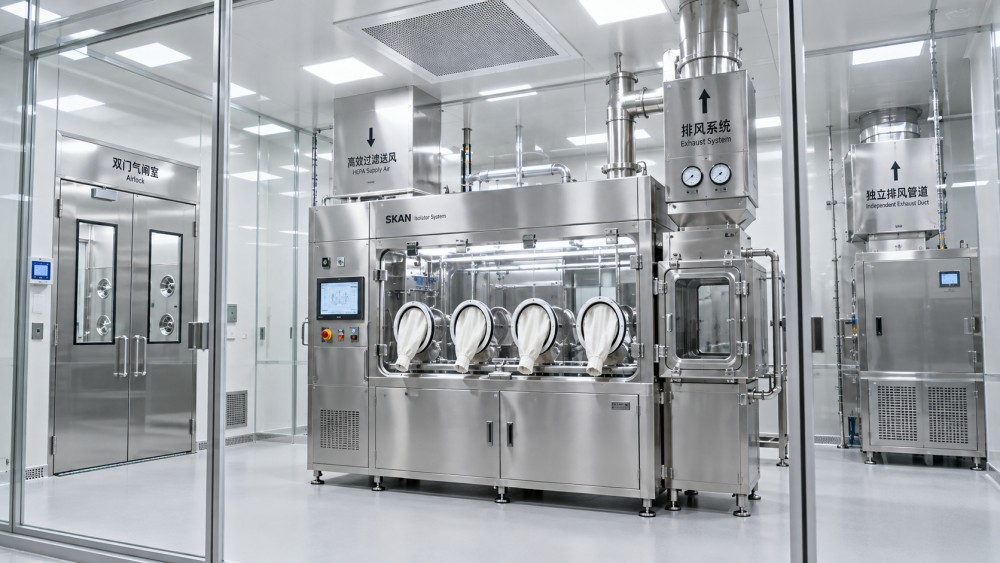
A pressure-cascade diagram is useful at this stage because it connects room boundaries, airlocks, doors, and exhaust paths. It should show intended airflow during normal operation and identify what happens during door opening, ventilation failure, and shutdown. Room pressure readings alone cannot demonstrate protection during every transient condition.
NSF/ANSI 49 concerns Class II biosafety cabinets within its scope; it is not a certification framework for an entire containment facility or for Class III cabinets. Cabinet selection must account for the biological work and any chemical hazards, followed by installation and performance verification appropriate to the cabinet type.
Exhaust treatment, waste decontamination, and effluent controls follow the containment assessment and applicable local requirements. They should not be inferred solely from a room’s ISO class or from the presence of a biosafety cabinet.
Set process-specific criteria for devices and electronics
Medical device cleanroom requirements depend on the device, manufacturing stage, and contamination risks. Sterile labeling does not automatically mean the entire manufacturing area needs pharmaceutical aseptic grades. For a terminally sterilized device, environmental controls still need to support validated bioburden limits, material compatibility, and packaging requirements. Sterilization does not necessarily remove particles, residues, or endotoxin.
Semiconductor projects require a similar separation between particle classification and process suitability. A room can meet its particle target while airborne molecular contamination affects sensitive surfaces. Define the contaminants relevant to the process and the corresponding measurement methods; a general particle report cannot substitute for that evidence.
SEMI S2 provides equipment environmental, health, and safety guidance within its scope. Its relevance to a tool does not make it the governing cleanroom classification standard. Utility purity, chemical delivery, and equipment safety need their own specifications, linked to the processes they support.
Turn applicability decisions into verifiable specifications
Create a requirements register before detailed design. Each entry should identify the source, why it applies, the affected room or system, the acceptance criterion, and the evidence required to demonstrate conformity. Record the applicable edition and any jurisdiction-specific adoption or modification.
Separate the entries into legal obligations, standards adopted to support compliance, and contractual requirements. A customer’s contamination limit can be contractually binding without being a statutory limit. Conversely, a contract that omits a legal requirement does not remove that obligation.
Translate broad requirements into testable statements. Replace “ISO Class 7 compliant” with a specification identifying the classified area, occupancy state, particle sizes, applicable standard, and reporting requirements. Define separate criteria for filter integrity, airflow behavior, pressure relationships, and microbiological performance wherever those assessments are required.
Allocate responsibility for interfaces. A room contractor can deliver the enclosure and ventilation system while process equipment changes airflow patterns, heat loads, and contamination generation. Integrated acceptance should reflect the installed configuration and representative activities. Otherwise, individually acceptable components can leave unresolved performance gaps.
Procurement documents should distinguish component evidence from installed-system evidence. Filter test documentation, cabinet certification, and room classification reports answer different questions. Require records that identify the tested item, configuration, method, instruments, results, and deviations so that each claim can be traced to its supporting evidence.
Keep the applicability decision current after handover
The selected requirements remain valid only while the underlying process assumptions hold. Introducing a new biological agent, changing from closed to open processing, increasing occupancy, or moving to a new product market can alter the compliance basis. Equipment relocation can also affect airflow protection without changing the nominal room class.
Build these triggers into change control. Assess whether the change affects the requirement register, qualification scope, monitoring locations, or operating procedures before implementation. A change with no effect on particle classification can still require reassessment of containment or microbiological controls.
The project’s standards decision should be traceable through a short chain: the activity creates a defined risk or legal obligation; a requirement addresses it; a design feature implements the requirement; and an agreed test or operating record demonstrates performance. That chain provides a practical basis for design review, acceptance, and later changes.
Related News
- Biosafety Laboratory Design: Planning Layout, Airflow and ContainmentNov 01, 2026Explore biosafety laboratory design principles for safer layouts, directional airflow and containment. Learn how to reduce risks and plan with confidence.
- Choosing Exterior Doors and Windows: Materials, Insulation and SecurityOct 31, 2026Compare exterior doors and windows by material, insulation, and security. Discover practical tips to choose the right fit for your climate, budget, and home.
- Manufacturing Industry Market Analysis: Demand and Supply Chain ShiftsOct 30, 2026Explore our manufacturing industry market analysis to understand demand shifts, supply chain risks, and smarter investment decisions.
- Choosing Furniture Hardware: Load Capacity, Fit, and Mounting RequirementsOct 29, 2026Choose furniture hardware with confidence. Discover how to assess load capacity, fit, mounting strength, and cleanability for reliable laboratory and controlled-environment installations.