Related News
- 00
0000-00
Biosafety Laboratory Design: Planning Layout, Airflow and Containment - 00
0000-00
Choosing Exterior Doors and Windows: Materials, Insulation and Security - 00
0000-00
Manufacturing Industry Market Analysis: Demand and Supply Chain Shifts - 00
0000-00
Choosing Furniture Hardware: Load Capacity, Fit, and Mounting Requirements - 00
0000-00
Renewable Energy Price Trends: Why Solar and Wind Power Prices Fluctuate
Weekly Insights
Stay ahead with our curated technology reports delivered every Monday.
A bioprocessing facility may generate spent culture medium, equipment rinse water, and cleaning effluent through the same production area, yet those streams do not necessarily need the same treatment. Effluent decontamination is required when the applicable biological risk assessment, containment requirements, authorization conditions, or discharge rules demand inactivation before release. A dedicated effluent decontamination system is not automatically required merely because the operation involves biotechnology.
Is an effluent decontamination system required for bioprocessing waste? The practical answer depends on what can enter the wastewater, whether another validated treatment route already controls the hazard, and what the receiving sewer or disposal facility permits. Getting this decision wrong can create an uncontrolled release pathway—or lead to purchasing a large treatment installation when segregated collection and approved disposal would be sufficient.
Separate the treatment requirement from the equipment decision
Two questions are often combined too early: must the waste be decontaminated, and must that decontamination occur in a centralized system? The first concerns biological safety and compliance. The second concerns how the facility reliably meets those obligations.
An effluent decontamination system, or EDS, collects and treats potentially contaminated liquid before controlled discharge. Depending on its design, it may use heat, chemicals, or another validated inactivation method. It is distinct from ordinary wastewater treatment, which primarily addresses pollutants such as organic loading, suspended solids, and nutrients.
A requirement to inactivate biological material does not always prescribe one equipment architecture. For small, segregated volumes, an authorized approach may involve suitable contained collection, validated treatment in compatible equipment, or transfer to an approved waste contractor. High-volume operations or containment arrangements that prohibit untreated liquid from leaving a defined boundary may make a dedicated EDS necessary.
Neither outsourcing nor dilution substitutes for a required inactivation step. Off-site disposal is an option only where the authorization, transport rules, packaging arrangements, and receiving facility acceptance allow it.
Identify which liquid streams actually carry biological risk
Start with a drainage and waste-flow map, not the total daily water consumption. A process using nonpathogenic production organisms presents a different assessment from one handling infectious material. Even within one process, wastewater collected before a validated inactivation step differs from wastewater generated afterward.
The inventory should identify the biological material handled, its potential hazards, the liquid streams it can enter, and the point at which those hazards are controlled. Genetically modified organisms may carry additional containment or environmental-release obligations, even where the production host is not normally considered pathogenic.
Production documentation alone may miss some pathways. Sampling stations, equipment low points, filter housings, and maintenance drains can retain contaminated liquid after the main batch has moved elsewhere. Trace these connections physically and compare them with piping drawings. A nominally clean drain should not be excluded solely because contamination is uncommon.
Also distinguish viable organisms from other hazards. A treatment process validated for microbial inactivation may not adequately control toxins, endotoxins, hazardous chemicals, or biologically active residues. These may require separate controls or disposal restrictions.
Establish what the facility is obliged to do
The compliance review should combine the facility’s biological risk assessment with its operating permissions and wastewater acceptance conditions. No single label—“GMP facility,” “bioprocessing plant,” or a stated biosafety level—fully answers the discharge question.
- Containment obligations: Determine which liquid pathways fall within the containment boundary and whether they require treatment before crossing it.
- Organism-specific conditions: Review permissions covering infectious agents, genetically modified organisms, or other regulated biological materials.
- Wastewater permissions: Confirm what the sewer authority or receiving treatment facility accepts, including biological restrictions and chemical limits.
- Waste transfer conditions: Where liquids leave as collected waste, confirm classification, containment, transport, and receiving-site requirements.
Higher-containment facilities commonly face more stringent liquid-waste controls, but exact requirements vary with the jurisdiction, agent, activity, and facility authorization. A biosafety designation should therefore trigger a detailed review, not an unsupported assumption about a particular system design.
GMP expectations address controlled, documented operations and prevention of contamination; they do not independently establish a universal requirement for centralized effluent decontamination. Similarly, compliance with cleanroom or biosafety cabinet standards does not demonstrate that a wastewater discharge route is acceptable.
Record the requirement and its source for each stream. Where wording is ambiguous, resolve it with the responsible biosafety authority and wastewater regulator before specifying equipment. This prevents a vendor’s standard configuration from becoming the facility’s assumed compliance basis.
Choose the treatment boundary before sizing the system
A useful decision sequence follows the waste from generation to its final permitted destination:
- Define the untreated boundary. Identify every location where potentially hazardous liquid exists before inactivation.
- Confirm the required endpoint. Establish the biological performance necessary for release, alongside any chemical discharge conditions.
- Review existing controls. Determine whether an upstream treatment step already achieves that endpoint under validated conditions.
- Compare collection routes. Evaluate source treatment, centralized treatment, and authorized off-site disposal against volume, containment, and operational needs.
- Document the selected route. Explain how routine operation, failures, maintenance, and abnormal waste generation remain controlled.
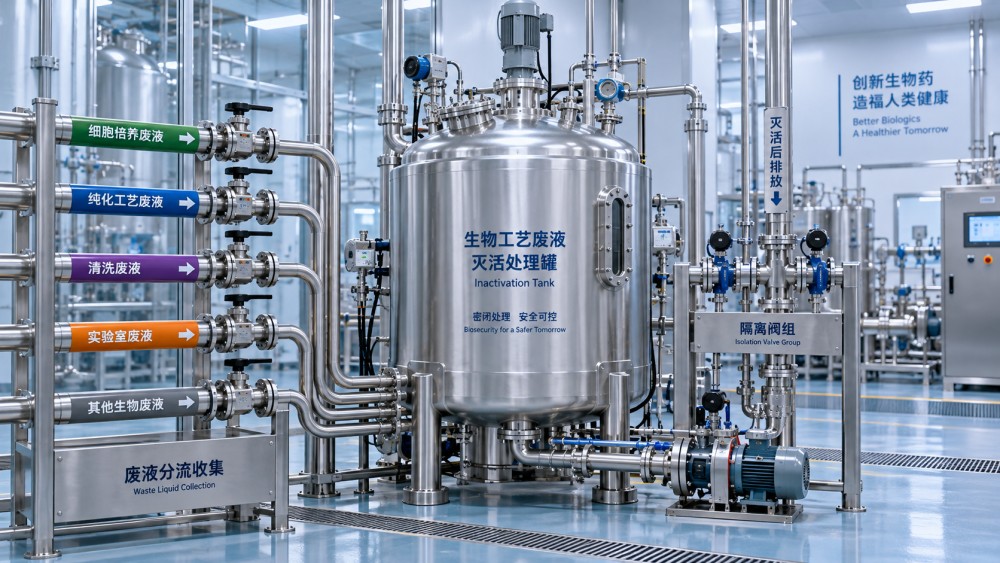
Segregation can substantially affect the equipment decision. Routing uncontaminated utility water into an EDS increases hydraulic demand and may reduce available capacity for contaminated batches. Conversely, separating streams without verified connections, suitable isolation, and clear operating procedures can create an untreated bypass.
The preferred boundary is one the facility can maintain and demonstrate. A theoretically smaller system offers little advantage if staff must repeatedly make difficult manual routing decisions or if future equipment additions can connect contaminated waste to an unrestricted drain.
Thermal and chemical treatment have different constraints
Both approaches can be appropriate, but neither is universally suitable. Selection should be based on the biological challenge, actual effluent composition, containment needs, and the facility’s ability to verify treatment performance.
Thermal treatment
Thermal systems depend on delivering the validated treatment conditions throughout the waste. Their suitability depends on heat transfer, mixing, solids content, and the behavior of the actual liquid—not simply the temperature displayed by one sensor.
Engineering considerations include heating and cooling capacity, vessel or piping suitability, instrumentation, and containment during filling and discharge. Fouling, accumulated solids, or poorly mixed regions can undermine performance. Continuous systems also need evidence that all effluent receives the required treatment without short-circuiting.
Thermal inactivation does not automatically remove dissolved chemicals or make the treated liquid acceptable for sewer discharge. Cooling and further wastewater conditioning may still be necessary.
Chemical treatment
Chemical systems rely on a disinfectant remaining effective in the actual waste matrix. Organic loading, solids, pH, mixing, and chemical compatibility can change performance. A disinfectant effective in a clean laboratory suspension may behave differently in concentrated culture waste.
Residual chemicals can create downstream discharge restrictions or worker-exposure concerns. Neutralization, where required, introduces another controlled step. Storage, dosing reliability, materials compatibility, and ventilation must also be considered.
A chemical system should not be selected solely because its initial utility demand appears lower. The comparison needs to include consumables, verification, residual management, maintenance, and the consequences of dosing failure. Treatment conditions must come from an approved validation basis rather than a generic recipe.
Specify performance that can be demonstrated
Once the treatment route is selected, procurement should begin with a user requirement specification. “Suitable for bioprocessing wastewater” is too broad to support a defensible purchase or acceptance test.
Define expected waste composition, variability, batch sizes, peak inflow, and abnormal operating scenarios. Include solids, foaming potential, cleaning chemical carryover, and conditions that could interfere with treatment. Average flow alone is inadequate when several pieces of equipment can discharge at once.
Validation should address representative worst-case conditions and use suitable challenge materials or surrogates selected by qualified personnel. Evidence should demonstrate the complete process, including collection, treatment, release controls, and handling of unsuccessful cycles. Equipment qualification and biological performance validation serve related but different purposes.
- Critical measurements: Identify the parameters that establish a successful treatment and how instruments are calibrated.
- Release logic: Define when discharge is permitted and what happens when treatment evidence is incomplete.
- Fault response: Specify containment during utility loss, sensor failure, interrupted treatment, or unavailable downstream discharge.
- Records: Retain treatment status, relevant measurements, alarms, interventions, and disposition decisions.
- Change control: Identify process, organism, waste-composition, and equipment changes that require reassessment.
A completed equipment cycle is not, by itself, proof of successful decontamination. The release decision must rely on the validated acceptance criteria, with clear handling of deviations.
Design for the days when treatment is unavailable
Production may continue generating liquid while the treatment system is stopped for maintenance or investigation. The facility therefore needs a defined response: adequate contained storage, a qualified alternative disposal route, or an enforced production stop. Storage capacity should reflect credible interruptions and peak waste generation rather than normal averages alone.
Untreated-side vents, overflows, drains, seals, and sampling arrangements belong within the containment review. Maintenance personnel also need a way to establish the equipment’s contamination status before opening it. A system that treats effectively during routine operation can still create exposure during cleaning or component replacement.
Finally, make the discharge decision traceable. For each stream, retain the hazard assessment, applicable requirement, selected treatment or disposal route, validation basis, and release authorization. Where a dedicated EDS is judged unnecessary, document the alternative controls and the changes that would trigger reconsideration—for example, a new organism, increased scale, revised drain connections, or modified discharge permissions.
Related News
- What Happens If an Effluent Decontamination Cycle Fails?Oct 15, 2026What happens if an effluent decontamination cycle fails? Learn how to verify containment, manage downtime, and confirm safe release with evidence-based recovery guidance.
- Is Effluent Decontamination Required for Bioprocessing Waste?Oct 14, 2026Is an effluent decontamination system required for bioprocessing waste? Discover when treatment is mandatory, compare compliant options, and avoid costly equipment mistakes.
- What pass box interlocking logic data should proveMay 22, 2026Pass box interlocking logic data should prove more than door control—verify contamination barriers, audit readiness, and operator compliance in regulated cleanroom and biosafety transfers.
- Why air shower nozzle velocity data can be misleadingMay 22, 2026Air shower nozzle velocity data can look impressive but often hides real performance gaps. Learn the checklist to assess airflow, filtration, coverage, and true contamination control.