
What happens if an effluent decontamination cycle fails? The immediate priority is establishing whether potentially infectious wastewater remains safely contained and whether discharge is blocked.
For laboratory directors, biosafety teams, and facility engineers, an alarm starts the investigation. It does not, by itself, establish whether treatment failed or containment was lost.
A failed cycle can trigger discharge lockouts, operational delays, and investigation of treatment parameters, equipment faults, or validation gaps. Recovery depends on the system and hazards.
Until an authorized review establishes otherwise, affected effluent should be treated as potentially infectious. Release requires evidence that the applicable treatment and discharge conditions were satisfied.
Does a Failed Cycle Mean Infectious Wastewater Has Escaped?
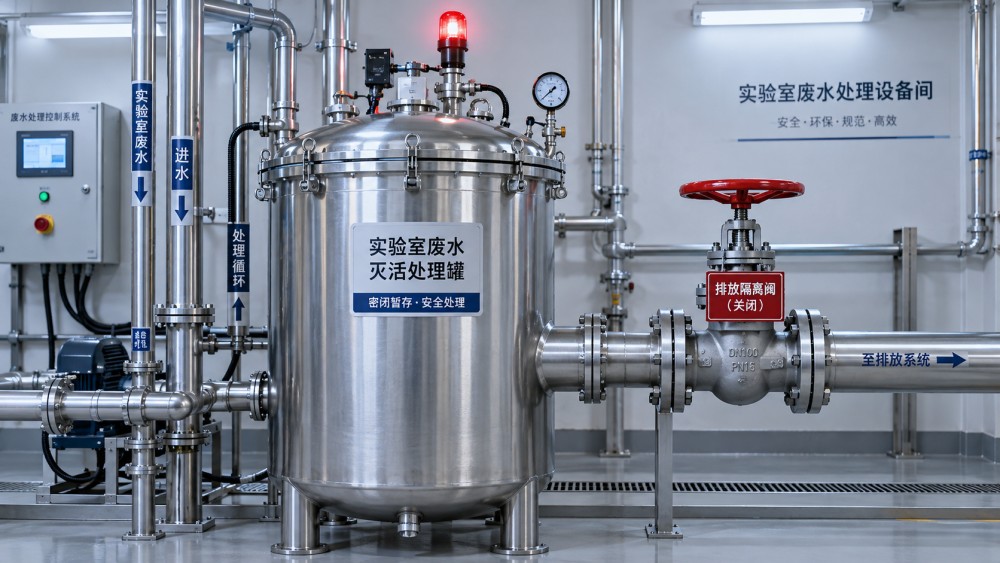
No. In a correctly designed and functioning system, an unsuccessful treatment cycle should prevent normal discharge, leaving the affected effluent within its designated containment boundary.
However, this outcome must be verified against the installed equipment. Designs differ, and a treatment alarm does not prove that discharge valves actually remained closed.
Three situations require different responses: confirmed containment with failed treatment, uncertain treatment status because records are incomplete, and suspected or confirmed release outside designated containment.
Confirmed containment usually creates an operational recovery problem. Suspected release creates an exposure and environmental response problem, requiring escalation under the facility’s incident procedures immediately.
The first useful question is therefore not simply why the cycle stopped. It is where the effluent is now and what prevents its release.
Operators should establish this through approved status checks and independent evidence where available. A reassuring screen indication alone may not demonstrate the physical containment condition.
What Should the Facility Do Immediately?
Follow the approved failure procedure, preserve the discharge restriction, and notify the designated operations and biosafety personnel. Avoid improvising recovery steps during an unresolved event.
Identify the affected batch or treatment interval, its source processes, and the potentially relevant biological hazards. These details determine the appropriate incident assessment and response.
Confirm available holding capacity and the current incoming wastewater rate. Continued laboratory activity can turn a contained treatment failure into a storage capacity problem quickly.
Restrict contributing activities when required by the contingency plan. The decision should account for storage headroom, expected repair duration, and access to qualified alternative treatment.
Preserve alarms, cycle histories, operator actions, and relevant maintenance records before resetting equipment. These records help distinguish a process failure from an instrumentation or documentation fault.
Do not bypass interlocks, manually drain untreated material, or assume that a repeated cycle is automatically acceptable. Recovery should follow an authorized, technically justified procedure.
How Does the System Decide That a Cycle Failed?
A cycle fails when it does not satisfy its defined acceptance criteria, or when the evidence needed to establish successful treatment is missing or unreliable.
Thermal systems may evaluate temperature, exposure duration, pressure, and other validated process conditions. Chemical systems may additionally depend on dosing, mixing, contact conditions, and effluent characteristics.
Acceptance criteria must come from the validated process and applicable operating requirements. A generic temperature, treatment duration, or chemical dose cannot establish suitability for every installation.
A sensor fault may invalidate the record even when treatment appeared normal. Conversely, a complete electronic record cannot compensate for an unrecognized process design weakness.
Some failures become apparent after apparent cycle completion, through record review, calibration findings, or other checks. Facilities therefore need procedures for retrospectively affected effluent too.
Where microbiological indicators or sampling support validation or periodic verification, their role must be defined. They do not automatically substitute for routine process acceptance criteria.
Which Safeguards Should Keep Failed Effluent Contained?
The essential safeguard is a release arrangement that prevents discharge unless defined conditions are met. Its effectiveness depends on equipment configuration, controls, and physical integrity.
Discharge permissives should reflect successful treatment and other required release conditions. Facilities should understand how those permissives behave during faults, interrupted cycles, and utility loss.
Valve position feedback can support verification, but its meaning depends on the design. An indicated closed position does not necessarily demonstrate a leak-tight isolation boundary.
Holding tanks, overflow management, secondary containment, and protected drainage arrangements should be evaluated together. A treatment vessel alone cannot address every potential loss-of-containment scenario effectively.
Fault response also depends on whether the plant uses batch processing, continuous treatment, or interconnected tanks. Each configuration creates different questions about affected volumes and isolation.
Ask for documented functional testing of relevant failure scenarios. Statements such as “fail-safe discharge” are less useful than evidence showing how the installed system responds.
Why Do Effluent Decontamination Cycles Fail?
Common causes include utility interruptions, heating faults, dosing problems, damaged valves, instrumentation drift, control errors, and operating conditions outside the validated range. Several causes can overlap.
Changed wastewater characteristics can also challenge an established process. Solids, chemical constituents, or loading patterns may affect treatment performance even when equipment appears operationally normal.
Maintenance can introduce additional risks if components are replaced incorrectly, instruments remain overdue for calibration, or configuration changes are not reviewed against the validated state.
Human factors matter as well. Unclear alarm messages, weak handover practices, and confusing restart permissions can prolong downtime or encourage actions that undermine the intended safeguards.
An investigation should separate the initiating fault from contributing weaknesses. For example, a utility interruption may expose inadequate storage planning or poorly defined restart criteria.
Replacing a failed component may restore operation without addressing the broader cause. Corrective action should explain why recurrence becomes less likely and how that will be checked.
When Can the Effluent Be Retreated or Released?
Retreatment may be possible when the material remains contained and an approved recovery procedure applies. Its suitability depends on the failure, effluent condition, and equipment status.
Before restarting, the responsible team should establish that the fault is corrected, required utilities are stable, instruments are suitable, and the system can perform its intended process.
Repeated treatment is not automatically harmless. Additional heating or chemical exposure may affect compatibility, waste characteristics, or downstream acceptance, depending on the effluent and treatment method.
Release should follow a satisfactory treatment record and any additional conditions specified by the facility. Depending on the process, these may include cooling or chemical discharge requirements.
If the original cycle’s effectiveness cannot be demonstrated, an alarm reset cannot convert that uncertainty into acceptance. The disposition decision needs a documented technical basis.
Restarting the equipment and authorizing discharge are separate decisions. The facility should identify who can approve each decision and what evidence that person must review.
What Changes If Effluent May Have Been Released?
Suspected release requires prompt escalation through the facility’s biosafety and environmental response arrangements. The immediate assessment should identify the pathway, affected area, and potentially exposed people.
The response should reflect the biological hazards, treatment evidence, estimated release extent, and downstream infrastructure. A drain connection alone does not establish the eventual environmental consequence.
Authorized personnel should determine whether access restrictions, occupational health involvement, environmental assessment, or external notifications are required. Reporting obligations vary by jurisdiction, permit, and incident circumstances.
Preserve relevant records and physical evidence when feasible under approved procedures. Uncoordinated flushing, cleaning, or sampling can complicate exposure assessment and erase information needed for investigation.
A suspected release should not be dismissed because no illness is apparent. Equally, an alarm should not be described as an environmental release without supporting evidence.
How Much Downtime and Business Disruption Should Managers Expect?
Downtime depends on repair complexity, available holding capacity, alternative treatment arrangements, and the evidence required for restart. The alarm itself cannot provide a reliable duration.
A minor instrumentation fault can still halt operations when treatment acceptance cannot be demonstrated. A larger mechanical fault may have limited impact if qualified redundancy exists.
Managers should request an estimate covering diagnosis, repair, verification, and authorized return to service. A repair completion time alone may substantially underestimate the operational interruption.
Business consequences can include restricted laboratory throughput, delayed production, contractor costs, additional waste handling, and investigation effort. The impact depends on which activities generate affected effluent.
Redundancy adds value only when it supports the required operating scenario. Shared utilities or controls can defeat apparently independent treatment equipment during a common failure.
Investment decisions should compare credible outage consequences against lifecycle costs. Storage capacity, maintainability, spare parts, and service response may offer benefits alongside additional treatment capacity.
What Evidence Supports a Defensible Return to Service?
A useful recovery record identifies the affected material, explains the failure, documents containment status, and records the final disposition. It should connect decisions to supporting evidence.
Include relevant cycle data, alarm histories, maintenance findings, instrument checks, and approved corrective actions. Record gaps explicitly instead of presenting an incomplete history as conclusive evidence.
Verification should match the change and failure mechanism. A straightforward repair may need targeted checks; a significant process modification may require broader qualification or revalidation.
The investigation should also consider earlier cycles where warranted. A newly discovered sensor problem, for example, may create uncertainty about records generated before the alarm.
Corrective and preventive actions should have owners, completion dates, and effectiveness checks. Closing the incident administratively should not substitute for confirming that the identified weakness was addressed.
A defensible decision rests on evidence proportionate to the risk. Neither a vendor assurance nor an operator’s confidence replaces the facility’s defined acceptance and authorization process.
What Should Directors and Procurement Teams Ask Suppliers?
Ask suppliers to explain the entire failure response, including affected-effluent retention, alarm escalation, discharge control, and recovery authorization. Evaluate these functions against the intended facility operation.
Request the validated operating envelope and its assumptions about effluent characteristics. Determine how changes in laboratory activities could affect the system’s suitability or require further assessment.
Clarify usable holding capacity under credible outage conditions, including incoming flows. Nominal tank volume alone does not show how long the facility can continue operating safely.
Review access to cycle records, audit trails, calibration support, spare parts, and qualified service. These capabilities influence investigation quality and recovery time throughout the equipment’s life.
For biosafety context, consult applicable national requirements and resources such as the CDC/NIH BMBL and WHO Laboratory Biosafety Manual, while checking local discharge obligations separately.
General cleanroom or equipment standards do not establish effluent treatment effectiveness by themselves. Procurement specifications should connect demonstrated performance to the facility’s hazards and release requirements.
The Practical Judgment: Containment First, Evidence Before Release
A failed effluent decontamination cycle should leave the facility with contained material, a restricted discharge pathway, and a defined recovery process. Verify those conditions immediately.
The decisive questions are whether containment remains intact, whether treatment effectiveness can be demonstrated, and whether sufficient capacity exists while the problem is investigated and corrected.
For directors, the strongest preparation combines tested safeguards, clear decision authority, accessible records, and realistic outage planning. These measures protect both biosafety and operational continuity.
Effluent is ready for release when the required evidence and authorization support that decision. An alarm reset or completed repair, by itself, cannot establish safe discharge.