
Weekly Insights
Stay ahead with our curated technology reports delivered every Monday.
Choosing between Laminar Flow Units and FFU systems affects airflow control, GMP compliance, maintenance strategy, and long-term cleanroom engineering performance. For buyers, operators, and technical evaluators working across regulated labs and advanced production sites, the real difference is not just “standalone unit versus ceiling module.” What really changes is how clean air is generated, controlled, validated, maintained, and scaled over time. In most projects, a laminar flow unit is better when you need localized, highly targeted unidirectional protection over a critical zone, while an FFU-based system is usually the stronger choice when you need modular cleanroom coverage, flexible layout expansion, and distributed airflow management. The right decision depends on process risk, facility architecture, compliance expectations, maintenance access, and total lifecycle cost.
What decision-makers really need to know first
When users search for “Laminar Flow Units vs FFU,” they are rarely looking for a textbook definition. They usually want to answer one practical question: Which option is better for my application, budget, compliance target, and facility design?
For most target readers, the core concerns are:
- Will it achieve the required cleanliness level?
- How does airflow performance differ in real use?
- Which system is easier to integrate into a cleanroom, lab, or production line?
- What changes in maintenance, filter replacement, energy use, and downtime?
- Which option is safer and more defensible under GMP, ISO 14644, or internal validation protocols?
- Does the choice affect automation layouts, process protection, operator workflow, or expansion plans?
That is why the most useful way to compare these systems is not by category label alone, but by air delivery logic, installation model, operational control, and risk profile.
Laminar Flow Unit vs FFU: the short answer
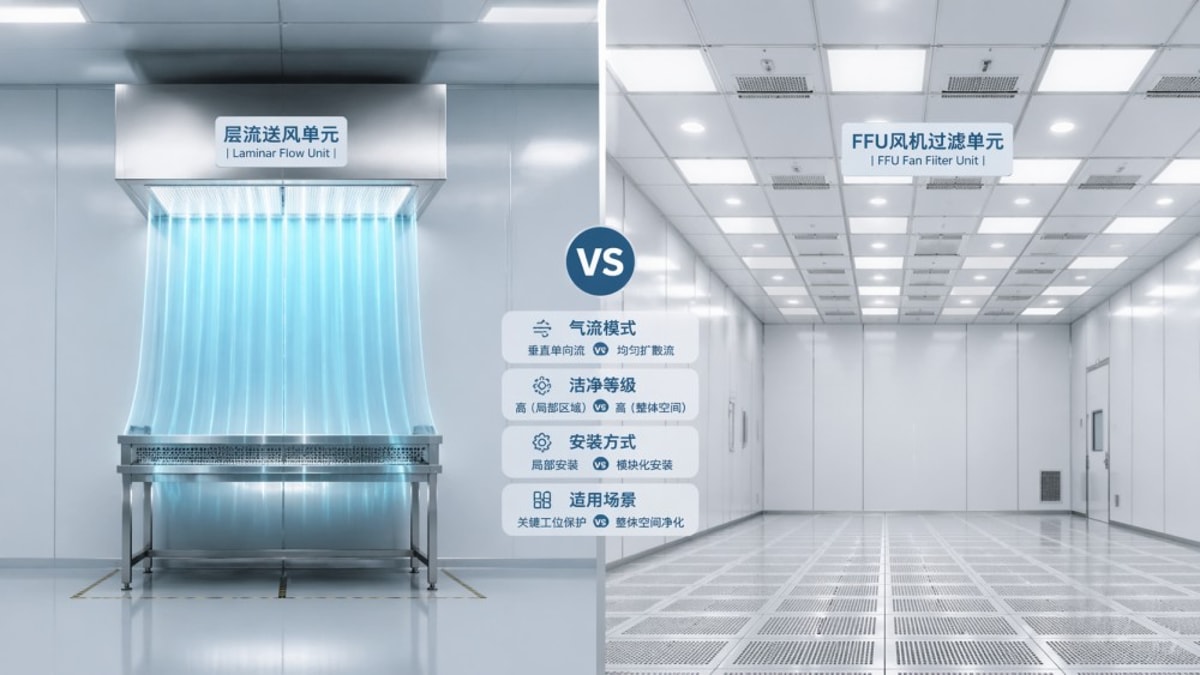
A Laminar Flow Unit is typically a localized clean air device designed to create a defined unidirectional airflow zone over a bench, process point, pass-through area, weighing station, sampling zone, or other critical work area. It is often selected when the objective is to protect product, sample, or process in a limited footprint.
An FFU (Fan Filter Unit) is a self-powered filtration module, usually installed in a ceiling grid or structural plenum, to supply filtered air across a broader cleanroom or controlled environment. FFUs are often chosen when the objective is to build or scale an entire clean zone using modular distributed airflow.
So what really changes?
- Coverage area: Laminar flow units protect a local zone; FFUs support room-level or line-level clean air architecture.
- System design: Laminar flow units are often point solutions; FFUs are infrastructure building blocks.
- Airflow control strategy: Laminar flow units focus on directional process protection; FFUs focus on distributed volume and room uniformity.
- Maintenance logic: Laminar units are fewer and more concentrated; FFUs may be numerous, creating a different maintenance burden.
- Scalability: Laminar units are ideal for isolated critical tasks; FFUs are stronger for modular cleanroom expansion.
- Project economics: The lower upfront option is not always the lower lifecycle-cost option.
How airflow performance changes in real operating conditions
For technical evaluators and operators, airflow behavior is where the comparison becomes meaningful.
Laminar Flow Units are designed to establish a stable unidirectional curtain or column of clean air over a defined working area. Their value lies in predictable local protection. In applications such as aseptic preparation support, electronics assembly, powder handling, optical inspection, or precision dispensing, this localized airflow can reduce particulate intrusion where it matters most.
FFUs, by contrast, work as a distributed air supply network. Multiple units across a ceiling can create broad clean coverage and help maintain room classification. In semiconductor, medical device, pharma support spaces, and high-spec assembly environments, this modularity is attractive because airflow can be tuned by adjusting unit quantity, arrangement, and fan speed.
But performance differences appear under real conditions:
- Airflow uniformity: A well-designed laminar flow unit can deliver very stable flow over one critical zone. A well-designed FFU array can deliver room-wide consistency, but only if spacing, ceiling coverage, return air path, and balancing are properly engineered.
- Obstruction sensitivity: Local laminar flow can be disrupted by operator movement, equipment placement, or poor sash/work-surface geometry. FFU-based rooms can also suffer from turbulence if tall equipment blocks flow or return paths are poorly planned.
- Recovery performance: FFU systems often provide stronger room-level recovery options after contamination events because they support larger air volume strategies. Laminar flow units are not intended to “fix” an entire room problem.
- Pressure relationship impact: In GMP or containment-adjacent facilities, FFU integration may interact more directly with room pressurization strategy, while a local laminar flow unit may be easier to isolate from broader HVAC redesign.
In other words, if your question is “Which one gives cleaner air?”, the correct answer is: the one that matches the protection objective and is engineered properly for the real process environment.
Which option fits better for GMP, ISO, and regulated validation expectations
Compliance teams and quality managers do not approve equipment based on marketing language. They look at whether the selected solution can be qualified, monitored, and defended during audit or investigation.
From a regulatory and validation perspective, the key issue is not whether a system is called a laminar flow unit or an FFU. The issue is whether it can consistently support the required environmental state under defined operating conditions.
Laminar Flow Units may be easier to validate when:
- the critical zone is clearly defined,
- the airflow path is visible and limited,
- the process requires local product protection, and
- the surrounding room does not need the same classification level as the work point.
FFU systems may be preferable when:
- the entire room or production bay must meet a target ISO class,
- future expansion is likely,
- multiple process stations share the same cleanliness requirement, and
- distributed monitoring and airflow balancing are part of the facility strategy.
For GMP compliance, decision-makers should evaluate:
- air velocity and uniformity mapping,
- HEPA/ULPA integrity test access,
- non-viable and viable monitoring compatibility,
- cleanability of exposed surfaces and housing design,
- alarm and control integration,
- change control impact when filters or motors are replaced,
- and how the solution fits the site’s qualification model: IQ, OQ, PQ.
If your organization operates under strict regulatory frameworks, the better system is usually the one that creates the fewest validation ambiguities and the lowest deviation risk over years of operation.
What changes in maintenance, downtime, and lifecycle cost
This is often where procurement teams and facility managers discover that an apparently simple comparison was not simple at all.
Laminar Flow Units can look attractive because they are focused assets. If you only need protection at one or several workstations, they may avoid the cost of a larger FFU-based infrastructure. Maintenance is also easier to visualize: fewer units, fewer fans, fewer points of failure.
However, if many isolated laminar flow units are installed across a facility, maintenance can become fragmented. Different unit models, inconsistent filter specifications, and decentralized servicing can increase operational complexity.
FFU systems offer modularity, but that modularity comes with a maintenance model of its own. A large FFU cleanroom may include dozens or hundreds of fan filter units. That can improve redundancy, but it also means:
- more motors to monitor,
- more units to clean and verify,
- more replacement planning,
- and greater importance of centralized controls and standardized spare parts.
Lifecycle cost should be evaluated across five areas:
- Initial equipment and installation cost
- Energy consumption over expected operating hours
- Filter replacement frequency and labor access
- Downtime impact on production or research continuity
- Upgrade or expansion cost after 2–5 years
In many facilities, FFUs perform better economically when the clean area is large and future changes are expected. Laminar flow units often perform better when only a limited number of critical zones need protection and room-wide cleanroom conversion would be excessive.
How the choice affects cleanroom layout and laboratory automation integration
For project managers, engineers, and automation planners, one of the most underrated questions is how airflow equipment interacts with physical workflow.
A local laminar flow unit can be highly effective in a targeted process cell, but only if it does not interfere with:
- robot reach envelopes,
- instrument loading access,
- operator ergonomics,
- material transfer paths,
- and line-of-sight process supervision.
In laboratories using automated liquid handlers, imaging systems, weighing platforms, or enclosed analytical devices, the wrong laminar flow geometry can create turbulence around moving arms, doors, or accessories.
FFU-based designs can better support open-plan automation layouts because clean air is supplied from above across a wider area. This may simplify integration for modular production lines, advanced assembly systems, or scalable laboratory automation islands. But it also requires careful return-air design and coordination with tall equipment, conveyors, enclosures, and service drops.
Ask these planning questions early:
- Will the process remain localized, or will more stations be added?
- Does the layout require future relocation of equipment?
- Will overhead service integration compete with FFU placement?
- Do moving systems disturb critical airflow paths?
- Is the clean air strategy compatible with operator behavior and maintenance access?
The best-performing clean air solution on paper can underperform badly if it is inserted into a workflow it was never designed to support.
Why HEPA filter manufacturer quality and component selection matter more than many buyers expect
Whether you select a laminar flow unit or an FFU, the filtration train is not a commodity detail. Filter quality, housing integrity, fan consistency, seal design, and testability directly affect real-world performance.
This is especially important when comparing vendors that appear similar in datasheets.
A qualified HEPA filter manufacturer should be assessed not only on efficiency claims, but also on:
- manufacturing consistency,
- leak-test traceability,
- pressure drop stability,
- media durability,
- frame and gasket quality,
- compatibility with your decontamination or cleaning methods,
- and long-term supply reliability.
Poor component quality can erase the theoretical advantage of either system. An FFU array built with inconsistent filters can create uneven room performance. A laminar flow unit with unstable fan output or weak sealing can compromise a critical process zone.
Buyers should also distinguish between product protection equipment and personnel/environmental protection equipment. A laminar flow unit is not a substitute for a biosafety cabinet when hazardous biological materials require containment. If the application involves infectious agents, cytotoxic compounds, or cross-contamination risk requiring containment, the correct comparison may actually be between a process clean-air device and an appropriately classified biosafety cabinet, not simply laminar flow unit versus FFU.
When a laminar flow unit is the better choice
A laminar flow unit is often the better solution when:
- you need localized unidirectional clean air over a specific task,
- the surrounding room does not justify full FFU coverage,
- the process requires focused product protection rather than whole-room control,
- installation speed and simplicity are priorities,
- you want to isolate investment to a few critical stations,
- and maintenance access is easier with standalone or dedicated units.
Common examples include sample preparation, sterile support handling in non-hazardous contexts, electronics inspection, optics assembly, weighing, dispensing, and specialized workstation protection.
When an FFU system is the better choice
An FFU system is often the stronger option when:
- the room itself must achieve and maintain a defined clean classification,
- multiple work zones share the same cleanliness target,
- future expansion or layout change is likely,
- distributed airflow control is preferable to a centralized local solution,
- ceiling-grid modularity supports project phasing,
- and the facility strategy values scalable, repeatable cleanroom engineering.
This is common in semiconductor support spaces, modular cleanrooms, medical device manufacturing, pharma support environments, precision assembly lines, and advanced technical production nodes where room-wide cleanliness is integral to process quality.
A practical evaluation checklist before you decide
Before selecting either option, technical and commercial stakeholders should align on the following:
- Protection objective: product, process, room, operator, or combined?
- Required cleanliness level: local point protection or room classification?
- Compliance context: ISO 14644, GMP, internal QA, sector-specific standards?
- Application risk: particulate sensitivity, microbial risk, containment boundaries?
- Layout constraints: ceiling height, return air path, utilities, automation movement?
- Service model: in-house maintenance or vendor-supported maintenance?
- Expansion horizon: stable process or evolving production platform?
- Total cost of ownership: not just CapEx, but energy, spares, downtime, and validation effort?
If different departments are involved, this checklist helps prevent a common failure: purchasing a technically acceptable system that becomes operationally inefficient six months later.
Conclusion: what really changes is the operating model
Laminar Flow Units and FFUs can both support high-performance controlled environments, but they do so in fundamentally different ways. A laminar flow unit changes the cleanliness of a specific process zone. An FFU changes the cleanliness strategy of a space. That difference affects airflow behavior, compliance logic, maintenance structure, automation compatibility, and long-term project economics.
If your need is precise, local, and process-centered, a laminar flow unit is often the smarter choice. If your need is scalable, room-oriented, and infrastructure-driven, an FFU system will usually deliver more strategic value. In either case, success depends on proper engineering, qualified filtration components, and a realistic understanding of how the system will actually be used.
The best buying decision is not the one with the most impressive specification sheet. It is the one that protects the process, fits the facility, survives validation, and remains maintainable over the full lifecycle of the controlled environment.
Related News
- Laminar Flow Units vs FFU: What Really ChangesApr 29, 2026Laminar Flow Units vs FFU: compare airflow, GMP Compliance, Cleanroom Engineering, and Laboratory Automation needs. See how Biosafety Cabinets, HEPA filter manufacturer quality, and Regulatory Frameworks influence the right choice.
- Best HEPA Filter Manufacturer Questions to AskApr 29, 2026HEPA filter manufacturer selection starts with the right questions. Learn how Biosafety Cabinets, GMP Compliance, Cleanroom Engineering, and Laminar Flow Units buyers compare risk, performance, and support.
- Laminar Flow Units: When Are They the Better FitApr 29, 2026Laminar Flow Units vs Biosafety Cabinets: discover the better fit for GMP compliance, cleanroom engineering, laboratory automation, and cost-smart regulatory decisions.
- How to Vet a HEPA Filter Manufacturer in 2026Apr 29, 2026HEPA filter manufacturer vetting in 2026: learn how Biosafety Cabinets, GMP Compliance, Cleanroom Engineering, and Regulatory Frameworks shape safer supplier selection.