
Weekly Insights
Stay ahead with our curated technology reports delivered every Monday.
Choosing between Class III Biosafety Cabinets and isolators is a critical decision for facilities balancing containment, GMP Compliance, and operational efficiency. For teams involved in Biosafety Cabinets selection, Security Engineering, Laboratory Automation, and Regulatory Frameworks, understanding how these systems differ in protection, workflow, and validation is essential before investing in high-risk laboratory or cleanroom applications.
In practice, the decision is rarely about one device being universally better. It is about matching containment architecture to the process, the biosafety level, the cleanroom strategy, and the real operating model of the facility. A Class III biosafety cabinet is designed around sealed, gas-tight protection for maximum operator and environmental safety. An isolator, by contrast, may be configured for sterility assurance, toxic containment, aseptic filling, or combined barrier control, depending on the application.
For lab directors, validation teams, procurement officers, and project managers, the comparison affects capital budgeting, room layout, HVAC integration, decontamination workflows, and long-term maintenance planning. This guide explains the differences in a practical, specification-driven way so decision-makers can evaluate risk, compliance, and lifecycle performance with greater clarity.
Understanding the Core Difference Between Class III Biosafety Cabinets and Isolators
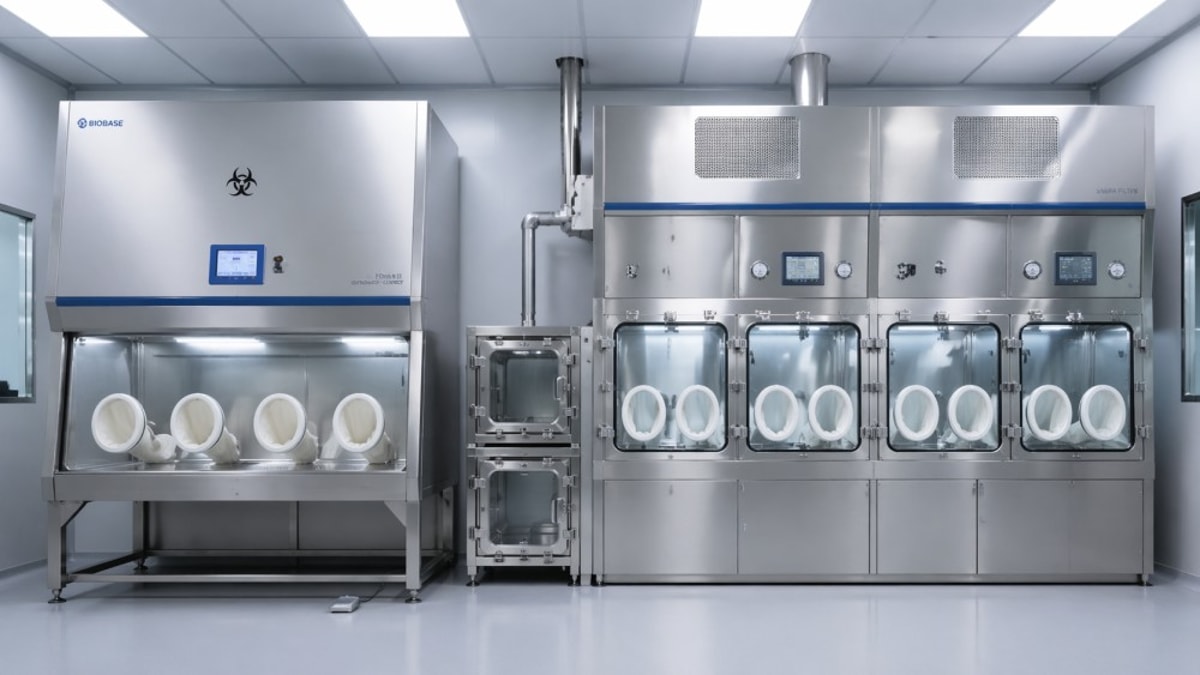
A Class III biosafety cabinet is a fully enclosed, ventilated containment device built for work with highly hazardous biological agents. It is typically operated through attached gloves, maintained under negative pressure, and connected to dedicated exhaust filtration. In high-containment environments such as BSL-3 enhanced or BSL-4 workflows, this sealed design reduces direct exposure pathways to an extremely low level.
An isolator is a broader category. It can be configured as a positive-pressure system for aseptic processing, a negative-pressure system for hazardous compounds, or a hybrid barrier system for specialized GMP applications. In pharmaceutical production, cell therapy, and high-value sterile compounding, isolators are often selected because they support process separation, repeatable decontamination cycles, and lower dependence on large cleanroom volumes.
The main distinction is purpose. Class III biosafety cabinets prioritize biocontainment first, then workflow. Isolators prioritize barrier separation for product, operator, or cross-contamination control, with containment level varying by design. This means two systems may look similar from the outside but perform very differently under validation, pressure cascade, and exhaust failure scenarios.
From an engineering perspective, Class III biosafety cabinets usually involve rigid containment boundaries, double HEPA filtration on supply or exhaust depending on design, pass-through autoclave or dunk tank integration, and highly controlled leak tightness. Isolators may offer more flexible chamber sizing, rapid transfer ports, VHP bio-decontamination, and robotics integration, especially where batch throughput ranges from 10 to 500 units per cycle.
Why the Terms Are Often Confused
Both systems create a physical barrier between the process and the operator. Both may use glove ports, transfer systems, and HEPA-filtered airflow. Both may be installed in regulated settings. However, the design intent, containment philosophy, and qualification criteria are not identical. Confusion often starts when buyers compare only external form factors rather than airflow logic, pressure regime, and decontamination validation requirements.
Typical classification logic used in projects
- Class III biosafety cabinet: selected where maximum biological containment and sealed manipulation are mandatory.
- Positive-pressure isolator: selected where sterility and product protection are primary, such as aseptic filling or sterile transfers.
- Negative-pressure isolator: selected where toxic or hazardous handling is needed, including potent compounds and some high-risk microbiological tasks.
- Hybrid or custom barrier system: selected where product protection and operator protection must be balanced in one process train.
The table below compares the two systems across the technical criteria most often used in feasibility studies and procurement reviews.
For most technical teams, the takeaway is straightforward: if biological risk level and sealed containment are the dominant drivers, a Class III biosafety cabinet is usually the benchmark option. If the process requires more configurable barrier management, higher batch handling flexibility, or GMP-focused aseptic workflow design, an isolator often offers a better operational fit.
Containment, Cleanliness, and Compliance Requirements
Containment and cleanliness are related, but they are not interchangeable. A Class III biosafety cabinet is engineered first to prevent release of hazardous biological material to the operator and surrounding environment. Isolators may be engineered to prevent contamination entering the process, contamination leaving the process, or both. That distinction has direct consequences for room classification, environmental monitoring, and HVAC design.
In a high-risk biological lab, pressure integrity and exhaust treatment may be reviewed against BSL expectations, institutional biosafety policy, and facility-specific emergency response procedures. In GMP manufacturing, isolator projects are commonly driven by Annex 1 expectations, media fill strategy, microbial control, and repeatable decontamination performance. A system that passes one compliance pathway may not automatically satisfy the other without redesign or additional qualification steps.
Leak tightness is a major differentiator. Class III biosafety cabinets are expected to maintain gas-tight or near gas-tight performance, often verified by pressure decay or leak testing during commissioning and periodic recertification. Isolators also undergo integrity testing, but acceptance criteria depend on intended use. In aseptic applications, firms may focus on glove leak testing frequency, VHP cycle reproducibility, and airborne particle control over a 20 to 60 minute validated cycle window.
Another important factor is filtration strategy. A Class III cabinet may require dedicated exhaust treatment through one or two HEPA stages, depending on site risk assessment and local code. Isolators may use unidirectional airflow, turbulent airflow, recirculation, or once-through exhaust designs. The right configuration depends on whether the process needs sterile exposure, hazardous powder handling, live-agent containment, or closed automated manipulation.
Compliance checkpoints that influence system choice
- Biological risk level and institutional biosafety approval process
- GMP zoning strategy, such as background room grade and isolator interface design
- Required decontamination cycle time, often 30–180 minutes depending on chamber size and method
- Recertification or requalification frequency, commonly every 6–12 months or after major intervention
- Filter change method, safe bag-in/bag-out provisions, and maintenance access constraints
The matrix below helps teams align compliance priorities with the most appropriate barrier technology.
For quality and safety leaders, the practical message is that compliance should be translated into testable user requirements before procurement starts. A 10-point URS that defines pressure mode, transfer method, decontamination target, alarm hierarchy, and maintenance access will reduce redesign risk far more effectively than comparing brochures alone.
Workflow, Ergonomics, and Automation Impact
Containment performance is only part of the buying decision. Daily usability often determines whether the installed system supports productivity or becomes a bottleneck. Class III biosafety cabinets are robust from a safety standpoint, but glove-only access, rigid chamber geometry, and strict transfer constraints can reduce speed for tasks involving frequent manipulations, multi-step assay preparation, or awkward device loading.
Isolators usually offer wider design flexibility. Chambers can be linear, modular, or segmented. Transfer can be managed through RTPs, airlocks, and integrated pass boxes. For production or repetitive workflows, this can reduce non-value-added operator movement and support cycle planning more effectively. In some aseptic or compound handling lines, facilities report workflow simplification when the number of manual touchpoints is reduced from 8–10 steps to 4–6 validated actions.
Ergonomics also matter. Poor glove port height, excessive reach distance, and limited visibility can increase fatigue in 2-hour to 4-hour operating windows. This affects not only operator comfort but also precision, error rate, and retraining frequency. Procurement teams should therefore request mock-up reviews or digital ergonomic studies during design freeze, especially when the system will be used across multiple shifts.
Automation integration is often easier with isolators because chamber layouts can be adapted to conveyors, filling systems, robotic arms, or automated sample transfer. Class III cabinets can also integrate automation, but mechanical interfaces, sealed penetrations, and serviceability must be engineered very carefully. The more complex the automation package, the more important it becomes to map preventive maintenance access before final approval.
Operational questions to ask before final selection
- How many glove interventions occur per batch, per shift, or per sample set?
- Will materials enter through autoclave, RTP, hatch, or manual transfer sequence?
- What is the acceptable decontamination downtime: under 45 minutes, 45–90 minutes, or above 90 minutes?
- Does the application require integration with robotics, balances, incubators, or filling modules?
- Can maintenance be completed without major containment breach or long cleanroom shutdown?
Typical workflow trade-offs
A Class III biosafety cabinet can be the correct answer where operator exposure tolerance is near zero and throughput is secondary. An isolator can be the better answer where repeatable processing, sterility, and modular automation determine business value. For project managers, the key is to quantify workflow impact early. Even a 15% loss in effective handling time can materially change staffing, batch release timing, and facility ROI over a 3- to 5-year horizon.
Distributors and integrators should also note that user acceptance testing should cover more than alarms and airflow. It should include real task simulation, glove reach verification, transfer path timing, and failure recovery scenarios. This is especially important where line uptime targets exceed 90% and operator retraining resources are limited.
Procurement Criteria, Lifecycle Cost, and Facility Integration
A technically correct system can still become a poor investment if lifecycle requirements were not evaluated at bid stage. Capital cost is only the first layer. Buyers should review installation complexity, utility loads, exhaust treatment, room modifications, decontamination consumables, glove replacement frequency, filter change method, and service response expectations. In many projects, the 5-year operating and maintenance burden is substantial enough to reshape the original technology preference.
Facility integration is a major hidden cost area. A Class III biosafety cabinet may require dedicated ducting, pressure monitoring interfaces, safe filter replacement infrastructure, and validated waste transfer pathways. An isolator may reduce surrounding cleanroom classification demands, but it can still require coordinated HVAC balance, VHP aeration management, condensate handling, and control system integration. Lead times also vary. Standardized systems may ship in 8–16 weeks, while highly customized high-containment or automated systems can extend to 20–40 weeks.
From a commercial evaluation standpoint, procurement teams should compare at least 4 dimensions: compliance fit, operational fit, serviceability, and total cost of ownership. A lower purchase price may not be attractive if glove changes require long shutdowns, or if annual recertification depends on specialized tools not locally available. Service network depth, spare part availability, and commissioning expertise should therefore carry meaningful weight in vendor scoring.
For multinational groups and high-value laboratories, FAT and SAT planning should be written into the purchase package. A structured 3-stage acceptance path covering factory inspection, site installation qualification, and operational challenge testing can prevent downstream disputes and accelerate release to production or research use.
Recommended procurement checklist
The table below summarizes the evaluation points that most directly affect risk, compliance, and lifecycle cost.
A disciplined procurement process usually reduces change orders and commissioning delays. As a rule, if the system touches biosafety, sterility assurance, or hazardous exhaust control, design reviews should include operations, quality, engineering, EHS, and procurement from the first specification cycle rather than after vendor selection.
Common Selection Mistakes and Practical Decision Guidance
One common mistake is assuming that the highest containment device is automatically the most suitable. Over-specifying a Class III biosafety cabinet for a process that mainly needs aseptic protection can increase cost, reduce throughput, and complicate maintenance without adding meaningful value. The opposite mistake also occurs: selecting a standard isolator for a biological hazard profile that actually requires a sealed high-containment approach.
Another frequent error is evaluating the barrier system without evaluating the full process envelope. Transfer ports, waste exit, room pressure cascade, decontamination chemistry, and emergency shutdown logic all influence actual performance. A well-designed core unit can still underperform if surrounding utilities, SOPs, and validation strategy are misaligned.
Decision-makers should also be careful with generic vendor language such as “high containment” or “aseptic ready” unless those claims are linked to measurable tests. Buyers should request defined acceptance criteria, such as leak test thresholds, recovery times, airflow visualization, glove integrity methodology, and alarm response logic. Measurable language supports both technical comparison and contract clarity.
A practical decision path is to start with the hazard, then map the process, then define qualification evidence. If the task involves highly infectious agents with near-zero tolerance for release, Class III is usually the reference technology. If the task centers on sterile handling, high repeatability, and efficient transfer in a GMP environment, an isolator is often more appropriate. Where both dimensions are relevant, custom engineering and early risk assessment are essential.
Quick decision framework
- Choose Class III biosafety cabinet when the top priority is sealed biological containment under negative pressure with tightly controlled exhaust management.
- Choose an isolator when the top priority is aseptic process control, flexible barrier configuration, or automated production workflow.
- Escalate to custom review when the process includes both live hazardous agents and stringent product sterility demands.
- Do not approve purchase until URS, FAT, SAT, maintenance access, and requalification scope are aligned.
FAQ: What do buyers most often ask?
Can an isolator replace a Class III biosafety cabinet? Sometimes, but only if its containment performance, pressure logic, transfer design, and validation package fully match the biological risk profile. In many high-risk pathogen applications, that substitution is not straightforward.
Which system is easier to validate? For aseptic GMP applications, isolators often fit established validation frameworks more directly, especially with VHP cycles and transfer control. For maximum biocontainment, Class III cabinets may be more appropriate, but their validation and facility integration can be more demanding.
How often should systems be requalified? A common practice is every 6 to 12 months, with additional testing after filter changes, relocation, glove replacement programs, or major maintenance. Site SOPs and local regulations should define the final schedule.
Class III biosafety cabinets and isolators solve different problems, even when they share gloves, barriers, and filtered airflow. The right choice depends on the hazard profile, cleanliness target, transfer strategy, automation plan, and long-term maintenance model. Teams that define requirements early and compare systems against measurable operational criteria usually make faster, safer, and more defensible decisions.
For organizations assessing high-containment laboratories, aseptic processing suites, or regulated cleanroom investments, a structured technical review can prevent costly specification gaps. To discuss system fit, validation scope, or project-level benchmarking for your facility, contact us to get a tailored solution, review product details, and explore more controlled-environment and biosafety options.
Related News
- Class III Biosafety Cabinets: Key Spec ChecksApr 29, 2026Class III Biosafety Cabinets guide covering Biosafety Cabinets specs, GMP Compliance, Security Engineering, HEPA filter manufacturer selection, and cleanroom integration—compare key checks before you buy.
- Class III Biosafety Cabinets vs Isolators ExplainedApr 29, 2026Class III Biosafety Cabinets vs isolators explained: compare Biosafety Cabinets, GMP Compliance, Cleanroom Engineering, and Laboratory Automation to choose the right containment system.