
Weekly Insights
Stay ahead with our curated technology reports delivered every Monday.
Choosing a biosafety cabinet without overbuying starts with one principle: buy for your actual risk profile, workflow, and compliance obligations—not for the highest specification on the brochure. Many labs overspend by selecting Class III biosafety cabinets, oversized units, or advanced laboratory automation features that do not improve safety for their real application. The better approach is to match cabinet class, airflow design, installation environment, operator needs, and regulatory framework to the work being performed. For procurement teams, lab operators, safety managers, and technical evaluators, that means balancing biosafety performance, GMP compliance, cleanroom engineering compatibility, maintenance burden, and total lifecycle cost before signing off on a purchase.
In practice, the core search intent behind “How to Choose Biosafety Cabinets Without Overbuying” is not simply to learn what a biosafety cabinet is. It is to understand how to avoid paying for unnecessary specifications while still meeting biosafety, product protection, and regulatory requirements. Readers want a decision method: what cabinet type is actually needed, what specifications matter, what features are optional, and where under-specifying creates risk. The most useful content therefore focuses on selection logic, application-based comparison, compliance fit, cost control, and common purchasing mistakes—not on generic definitions.
Start with the real decision: what risk, process, and compliance level do you actually need?
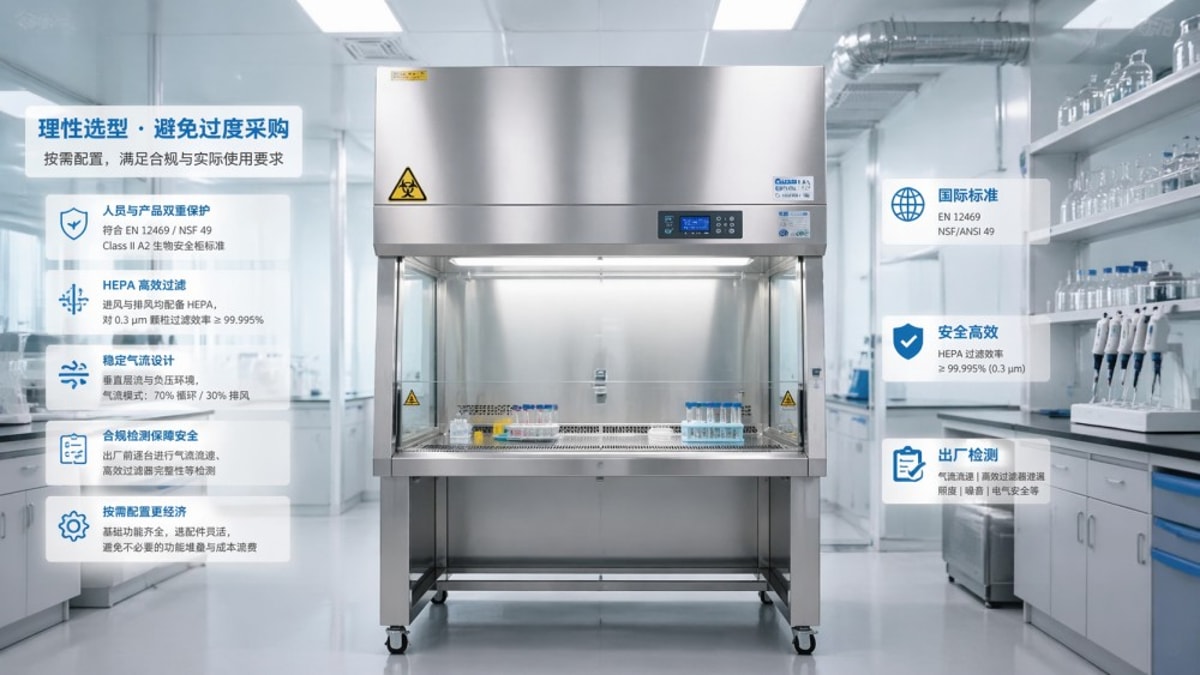
The biggest reason organizations overbuy biosafety cabinets is that they start with product tiers instead of application analysis. A higher cabinet class does not automatically create better value. It only makes sense if your materials, containment requirements, and operating environment justify it.
Before comparing models, answer five practical questions:
- What are you handling? Non-pathogenic cell culture, clinical specimens, pharmaceutical compounding, low- to moderate-risk microbiology, or highly dangerous agents all require different levels of protection.
- Who needs protection? The operator, the product, the environment—or all three? This determines whether you need a biosafety cabinet rather than a simple laminar flow unit.
- Which standards or regulations apply? NSF/ANSI 49, EN 12469, GMP guidance, institutional biosafety rules, and local certification requirements can eliminate unsuitable options quickly.
- Where will the cabinet be installed? Room airflow, HVAC balance, cleanroom pressure cascade, ceiling height, service access, and exhaust availability directly affect model suitability.
- How often will it be used? Light intermittent use does not justify the same investment as high-throughput, multi-shift operation in a regulated production environment.
For most buyers, this first step already prevents unnecessary escalation to premium systems. If your application does not involve the extreme containment conditions that justify a Class III biosafety cabinet, paying for one typically adds complexity, infrastructure demands, and operating cost without improving practical outcomes.
Know when you need a biosafety cabinet—and when you do not
One of the most expensive mistakes is confusing biosafety cabinets with other clean air equipment. A biosafety cabinet is designed to protect personnel, the product, and the environment through controlled inflow, downflow, and HEPA-filtered exhaust. A laminar flow unit, by contrast, is generally intended for product protection only and does not provide personnel protection from hazardous biological materials.
This distinction matters because some facilities over-specify in one direction, while others under-specify in the other:
- If your work is sterile but non-hazardous, a laminar flow unit may be sufficient and more economical.
- If your work involves infectious or potentially infectious materials, a proper biosafety cabinet is usually required.
- If your process is driven by hazardous drug handling or stringent aseptic requirements, the cabinet must be selected against both biosafety and process compliance expectations.
That is why cabinet selection should be integrated with broader cleanroom engineering and lab workflow planning. Buying a high-end unit in isolation often fails to solve the actual contamination or safety problem if room design, gowning discipline, exhaust planning, and certification practices are weak.
For most facilities, the key question is Class I, Class II, or Class III—not “what is the most advanced option?”
Overbuying often happens when buyers assume “more containment” is always safer. In reality, the right class depends on use case.
Class I biosafety cabinets provide personnel and environmental protection, but not product protection. They may fit specific applications where sample sterility is not a requirement.
Class II biosafety cabinets are the most common choice because they provide protection for personnel, product, and environment. For many microbiology, clinical, research, and pharmaceutical workflows, this is the practical center of the market. Within Class II, subtype selection still matters, especially if trace chemicals, radionuclides, or exhausted processes are involved.
Class III biosafety cabinets are fully enclosed, gas-tight systems intended for maximum containment. They are essential in a limited set of extreme-risk applications, but they are not a “premium upgrade” for ordinary labs. They require more infrastructure, different operating practices, and higher maintenance commitment. If your biosafety officer, process owner, and regulatory framework do not explicitly require this level of containment, it is often an example of overbuying.
For many organizations, the smartest purchase is a correctly specified Class II unit from a reliable manufacturer, properly installed and certified, rather than a more complex cabinet that exceeds operational need.
Focus on the specifications that actually affect safety, usability, and cost
Buyers often get distracted by feature lists. A better approach is to prioritize specifications that influence real-world performance.
1. HEPA filtration quality and integrity
The credibility of the hepa filter manufacturer, filter efficiency, leak testing protocol, and serviceability matter more than marketing language. Filtration quality directly affects containment confidence.
2. Airflow stability
Consistent inflow and downflow are central to cabinet performance. Ask how airflow is monitored, compensated, and verified during certification—not just what the nominal design value is.
3. Cabinet size matched to workflow
A larger cabinet is not automatically better. Oversized units consume more space and energy and may encourage poor ergonomics or improper loading. Choose a work area that supports actual batch size, tools, and operator movement.
4. Noise, sash design, and ergonomics
Operators who use the cabinet daily care about fatigue, visibility, arm comfort, and alarm clarity. Poor usability often leads to workarounds that undermine safety.
5. Decontamination and maintenance access
Filter replacement, cleaning access, service clearances, and certification convenience all affect lifecycle cost and downtime.
6. Exhaust configuration
Whether the unit is recirculating, canopy-connected, or hard-ducted can significantly affect installation complexity and facility integration.
7. Controls and monitoring
Not every lab needs advanced digital monitoring, remote telemetry, or highly integrated laboratory automation interfaces. These features can be valuable in multi-site, high-compliance operations, but unnecessary in simpler environments.
How to avoid paying for features your facility will never use
A practical anti-overbuying rule is to separate required features from nice-to-have features.
Usually required:
- Correct cabinet class and subtype
- Verified compliance with applicable standards
- Reliable HEPA filtration and airflow performance
- Safe ergonomics for routine operation
- Local service, certification, and spare parts support
Sometimes optional, depending on facility maturity:
- Advanced touchscreen control systems
- Building management system integration
- High-end data logging beyond regulatory need
- Automation-ready interfaces for workflows that remain manual
- Special finishes or premium materials not required by cleaning chemistry or process risk
This is especially important in mixed-use organizations where procurement teams may be influenced by future-facing narratives around precision instrumentation or automation. If the workflow, staffing model, and digital infrastructure are not ready to use those features, they become cost without return.
Total cost of ownership is where overbuying becomes visible
The purchase price is only one part of the decision. A biosafety cabinet that looks “safer” or “more advanced” on paper may cost substantially more over its operational life.
Evaluate total cost of ownership across:
- Initial equipment price
- Site preparation and facility modifications
- HVAC or exhaust integration
- Certification and validation
- Energy use
- HEPA filter replacement
- Service contracts and downtime risk
- Operator training requirements
For procurement officers and business evaluators, this is where disciplined specification control matters most. A moderately priced cabinet from a dependable supplier with strong service support may outperform a feature-heavy system that is expensive to install, difficult to certify, and underused by staff.
Common buying mistakes that lead to overspending or poor fit
Across industries, several patterns appear repeatedly:
- Buying for worst-case scenarios that are not part of normal operations instead of current validated use cases
- Assuming Class III is a safer default rather than a specialized containment solution
- Ignoring room integration and treating the cabinet as standalone equipment
- Choosing based on catalog features rather than operator workflow
- Underestimating certification and maintenance realities
- Failing to align safety, quality, engineering, and procurement teams early
For project managers and engineering leaders, one of the best safeguards is a cross-functional review: EHS, quality, users, facilities, and procurement should all sign off on the application definition before vendor comparison begins.
A simple decision framework for choosing biosafety cabinets without overbuying
If you need a practical method, use this sequence:
- Define the biological and process risk.
- Confirm whether personnel, product, and environmental protection are all required.
- Map applicable standards and internal compliance obligations.
- Check room conditions, exhaust options, and cleanroom engineering constraints.
- Select the minimum cabinet class and subtype that fully satisfies the requirement.
- Compare suppliers on filtration quality, airflow performance, service support, and certification readiness.
- Filter out features that do not improve your actual workflow, safety outcome, or compliance position.
- Review total lifecycle cost before final approval.
This framework helps technical evaluators and decision-makers stay disciplined. It also creates a clearer justification trail for regulated environments and internal capital approval processes.
Conclusion: buy the right biosafety cabinet, not the most expensive one
The right biosafety cabinet is the one that matches your actual risk, workflow, facility conditions, and regulatory framework with no safety gaps and no unnecessary complexity. In many cases, avoiding overbuying means resisting the urge to choose the highest containment class, the largest footprint, or the most digitized feature set when a properly specified Class II biosafety cabinet will do the job better and more efficiently.
For lab operators, that means better usability. For safety and quality teams, it means defensible compliance. For procurement and business leaders, it means stronger return on investment and lower lifecycle burden. If you begin with application reality, verify standards, assess cleanroom and facility integration, and focus on performance-critical specifications such as HEPA filtration, airflow, certification, and service support, you can make a confident decision without overspending.
Related News
- What Biosafety Cabinets Cost Beyond the Purchase PriceApr 29, 2026Biosafety Cabinets cost more than the purchase price—explore GMP Compliance, Regulatory Frameworks, Class III Biosafety Cabinets, Laminar Flow Units, and lifecycle risks before you buy.
- How to Choose Biosafety Cabinets Without OverbuyingApr 29, 2026Biosafety Cabinets buying guide: choose the right class for risk, GMP Compliance, Security Engineering, and Cleanroom Engineering—avoid overbuying and cut lifecycle cost.